- Kung Fu Kung Fu (功夫) is a general term for chinese boxing styles. Each chinese martial art cultivates its particular ensemble of principles which are encoded into prearranged fighting patterns called forms, sets or Tao Lu (套路).
- Pak Mei Pak Mei or Bak Mei (白眉) is cantonese, meaning White Eyebrow and is a traditional, internal and external kung fu style from southern china with hakka heritage supposedly developed by a shaolin monk. The Mandarin (Pinyin) transcription for Pak Mei is Bai Mei.
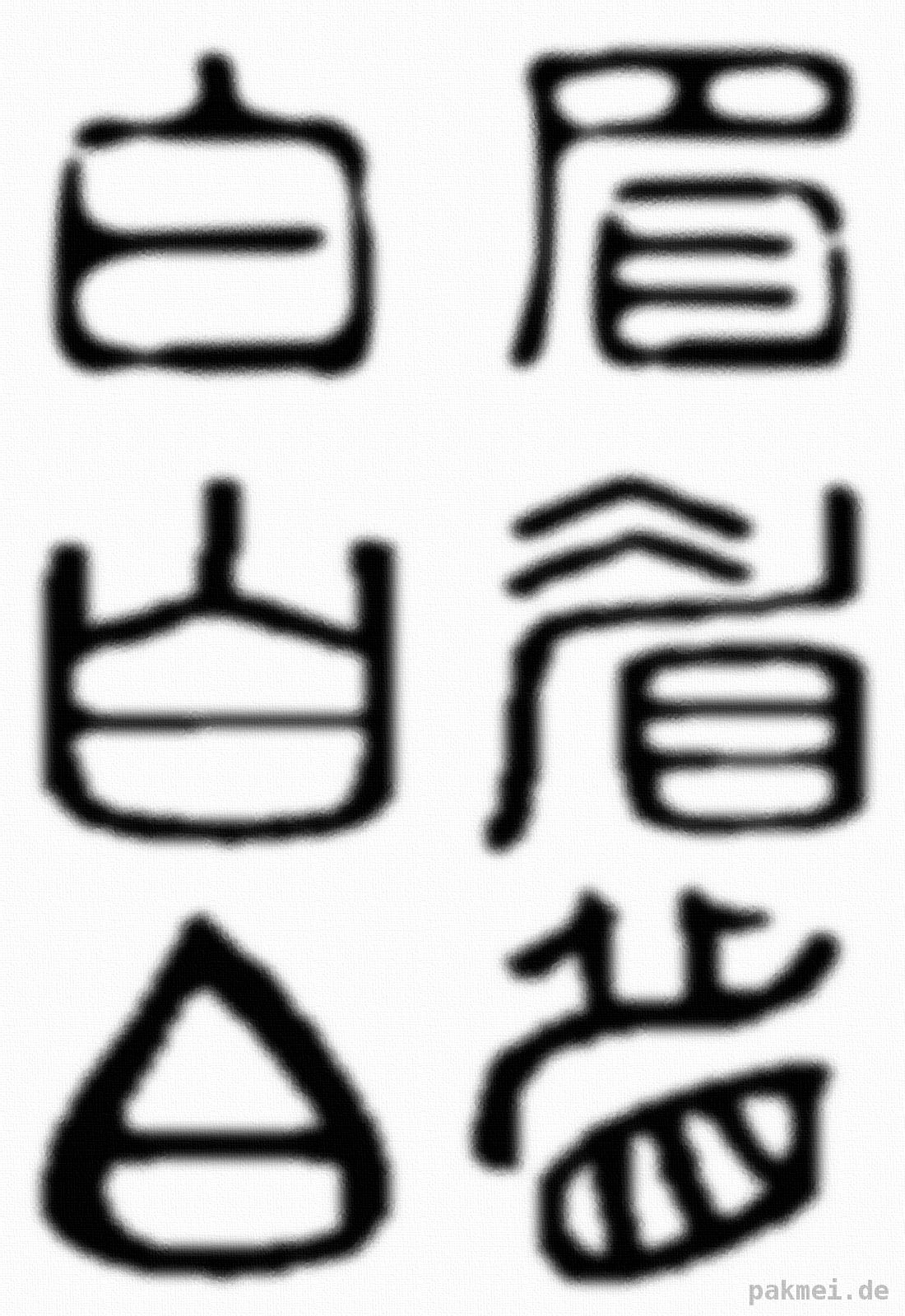
- Glyphs The first character means "White" (白), the second means "Eyebrow" (眉).
- Naming The name Pak Mei refers to the nickname of the style's founder, a monk who might have had white eyebrows or wore a then common white headband. The style was renamed from its original name Ngo Mei Siu Lam or Emei Shaolin (峨嵋少林) to Pak Mei by the founder's sole follower in honor of his master.
- Notation Alternative notations to Pak Mei are: Pak Mee, Pak Mae, Pai Mei, Pak May, Pat Mei, Pok Mei, Pei Mei, Bak Mei, Baak Mei, Bak Mee, Bak Mae, Bai Mei, Bach Mi, Bok Mei, Bei Mei, Pack Mei
- Names Sometimes Pak Mei is referred to by Pak Mei Kuen (白眉拳) meaning "White Eyebrow Fist", by Pak Mei Pai (白眉派) meaning "White Eyebrow Style", or by Pak Mei Ga meaning "White Eyebrow Family" (白眉家).
- Classification Pak Mei can be classified as a short-range, southern, external and internal kung fu style with buddhist origins.
-
-
- Existence The existence of a shaolin monk nicknamed Pak Mei, whose real name may have been Chu Long Tuyen, is fairly certain.
- 峨嵋山 (Ngo Mei Shan) Mount Emei This mountain has a connection to the Pak Mei style, as Juk Fat Wan lived in the Kwang Wai temple on mount Emei.
-
- Southern Shaolin The legendary monk Pak Mei was a white haired and browed monk in the southern shaolin temple.
- Burning Shaolin He is said to have participated in a rebellion to overthrow the ruling Qing dynasty, but later betrayed his fellow rebels to save his life and caused the destruction of this temple.
- Emei Able to flee with four fellow monks (Ji Sin, Ng Mui, Fung Dao Dak, Miu Hin) from the temple, he retreated to mount Emei in Sichuan province, to create his own kung fu style, which he tested upon Ji Sin (the legendary founder of Hung Gar) and killed him in the process.
- Validity This legend is the combination of at least two classic chinese novels without any historic claim.
-
-
- Gwong Wei The monk Gwong Wei was the sole student of the style founder Pak Mei.
- Juk Fat Wan Student of Gwong Wei and teacher of Cheung Lai Chuen.
-
- Cheung Lai Chuen (CLC) became the first secular grandmaster of Pak Mei Kung Fu.
- Lau Man Gar (流氓家) the style CLC learned first from Master Lam Shek.
- Li Gar (李家) the style CLC learned second from Master Li Yee.
- Lung Ying (龙形) the style CLC learned third from Master Lam Aa Hop.
- Pak Mei Pai / Pak Mei Kuen After being beat by the monk Lin Sang, a student of Juk Fat Wan, CLC sought out Juk Fat Wan and eventually convinced him to teach him Pak Mei as fourth style.
-
-
-
-
-
-
-
- 蘇劍光 So Kim Kwong ...
- 高蘇 Guo Sou ...
-
- 张炳发 Cheung Bing Fat ...
- 张炳林 Cheung Bing Lam ...
- ...
-
- 蓮生 Lin Sang ...
-
-
-
-
-
- 三角步 (Saam Gok Bo) Triangle Stance The triangle stance is the main stance of the Pak Mei system. The front legs knee is above the toes, the back leg is stretched. The front foot is a half foot length in front, and two foot length to the side of the back foot.
-
- Body The upper body posture has the shoulders bent forward but with a straight back and the pelvis tilted forward.
- Elbows The elbows are kept in front of the body as close together as possible and by this protecting the center of the body.
- Guard Usually, the left hand guards the right arm at the elbow with the right hand forming an upward facing fist.
-
- 拳 (Kuen) Fist For the basic fist the fingers are curled up tightly into the palm with the thumb pressing onto the index and middle finger. It is essential that the back of the hand is aligned flat with the forearm
- 鳳眼 (Fung Ngaan) Phoenix Eye Similar to the fist, but with the thumb pressing sideways on the middle finger, thus raising slightly the curled index finger and extending the index finger knuckle.
- 虎爪 (Fu Jow) Tiger Claw Fingers and thumb are spread and halfway curled, so that every finger is forming a hook.
- 南鷹爪 (Nan Ying Jow) Southern Eagle Claw Similar to the tiger claw but only using thumb, index and middle finger, the other two fingers are curled up as for a fist.
-
- 直步拳 (Jik Bo Kuen) Straight Step Fist Jik Bo Kuen is the most basic and essential form of the Pak Mei system. It contains the four dynamics. Jik Bo appears simple and is comparatively easy to learn, yet very hard to master.
- 九步推 (Gao Bo Toi) Nine Step Push This form is the most famous Pak Mei form. It embodies all principles of the white eyebrow system and appears external. Gao Bo Toi is the signature form of Pak Mei.
- 十八摩橋 (Sup Ba Mo Kiu) Eighteen Ghost Bridge A very complex and more internal form. Sub Ba Mo is very closely related to Gao Bo Toi.
- 猛虎出林 (Mang Fu Chu Lum) Fierce Tiger Exits Forest The highest hand form of the Pak Mei system, likely created by Cheung Lai Cheun.
-
- 十字拳 (Sub Ji Kuen) Cross Pattern Fist Beginner Form, included and adapted by Cheung Lai Chuen from Lau Man Gar.
- 三門拳 (Sam Mun Kuen) Three Gates Fist Beginner Form, included and adpated by Cheung Lai Chuen from Li Gar.
- 鷹爪黏橋 (Ying Jow Nim Kiu) Eagle Claw Touching Bridge Intermediate Form, included adapted by Cheung Lai Chuen from Lung Ying.
- 四門八卦 (Sei Mun Ba Gua) Four Gates, Eight Directions Intermediate Form designed and introduced by Cheung Lai Chuen combining Lau Man Gar, Li Gar, Lung Ying and Pak Mei.
- 地煞拳 (Dei Sat Kuen) Ground Demon Fist Intermediate Form with ground fighting elements.
-
- 徫雄拳 (Wei Hung Kuen) Wei Hung's Fist Beginner's form introduced by Wei Hung. Contains elements from other southern styles.
-
-
- 棍 (Gwun) Staff The most basic and common kung fu weapon, the "grandfather of weapons". Pak Mei features a heavy, conic pole.
- 單刀 (Dan Dao) Broadsword The chinese saber, literally: single knife, the "general of weapons".
- 槍 (Ceong) Spear A light staff with a short blade attached, the "king of weapons".
- 劍 (Gim) Sword A double edged sword, the highest basic chinese weapon, the "gentleman of weapons".
-
- 大耙 (Dai Pa) Tiger Fork A heavy three pronged fork, which has been used to hunt tigers.
- 關刀 (Guan Dao) General Guan Yu's Glaive Polearm weapon named after the famous general Guan Yu.
-
- 雙刀 (Seung Dao) Double Broadsword A set of twin broadswords
- 柺 (Gwai) Tonfa A short staff with a handle attached at the upper third. Typically used in pairs.
- 峨嵋刺 (Emei Ci) Emei Piercers Two rods each sharpened on both ends and with a centrally attached rotatable ring for the middle finger.
- 蝴蝶双刀 (Wu Dip Seung Dao) Butterfly Sword Short bladed single edge knives with protected handles and a thumb hook. Often used in pairs, sometimes singly with shield
-
- 凳 (Dang) Bench A wooden bench.
-
-
- 大陣棍 (Dai Chun Gwun) Big Combat Staff A southern single ended staff form; the first Pak Mei staff form.
- 白眉單刀 (Pak Mei Dan Dao) Pak Mei Broadsword An unusual (southern) broadsword form.
- 旋風雙刀 (Syun Fung Seung Dao) Whirldwind Double Broadsword ...
- 仙花宝凳 (Sin Fa Bo Dang) Immortal Flower Treasure Bench Traditional bench form, with some flashy moves.
- 白眉關刀 (Pak Mei Guan Dao) Pak Mei Guan Dao ...
- 白眉雙柺 (Pak Mei Seung Gwai) Pak Mai Double Tonfa ...
- 左右大耙 (Zo Jau Dai Pa) Left Right Tiger Fork ...
- 五行棍 (Ng Hang Gwun) Five Element Staff ...
- 白眉峨嵋刺 (Pak Mei Emei Ci) Pak Mei Emei Piercers ...
-
- Hand The first gate.
- Elbow The second gate.
- Shoulder The third gate.
-
- 吞 (Tan) Swallow ...
- 吐 (Tou) Spit ...
- 浮 (Fau) Float ...
- 沉 (Cam) Sink ...
-
- 牙 (Ngaa) Teeth ...
- 脖 (But) Neck ...
- 肩 (Gin) Shoulder ...
- 手 (Sau) Hands ...
- 腰 (Jiu) Waist ...
- 腳 (Goek) Feet ...
-
- Tight Centerline Keeping the elbows tight in front of the body is utmost essential.
- 驚扎勁 (Gink Jak Ging) Scared Power describes a sudden, explosive burst of power.
- Secret Master Techniques There are none! The only secret is diligent practice.
-
- 氣 Qi / Chi / Hei Literally means breath; actual meaning is reflected better by vitality or energy.
- An Exercise Starting position is a natural stance with straight back and slightly forward tilted pelvis. The hands are on waist level with the palms facing upward. During inhalation the arms are raised with the hands palms upward in front of the body but without raising the shoulders. During exhalation the arms are lowered palms downward in front of the body till waist level.
- Remark The essential principle behind all qigong exercises is that the breathing cycle controlls all motion.
-
- ☯ {Symbol} The symbol originated in the Ming dynasty depicting the contrasting yet interchanging forces of yin and yang.
- 陰 (jam) Yin is associated with softness, femininity and the moon.
- 陽 (joeng) Yang is associated with hardness, masculinity and the sun.
-
- 峨嵋少林 (Ngoh Mei Siu Lam) Omei Shaolin The core of the Pak Mei style.
- 龍形 (Lung Ying) Dragon Shape Hakka style, originally known as (southern) eagle claw, sister style to Pak Mei.
- 流氓家 (Lau Man Gar) Wanderer Fist/Vagabond Style Formed at the same time as Omei Shaolin in southern China by travelling beggars.
- 李家 (Li Gar) Lee Family Style One of the five famous family styles of southern chinese kung fu.
-
- 柔功門 (Yau Kung Moon) Soft Hand Style Southern shaolin style featuring "Soft Hand Power".
- 佛山白眉 (Foshan Bak Mei) Foshan White Eyebrow Foshan Bak Mei (also: Futshan, Fatsan) is a southern kung fu style with a similar name. Also, most of the forms share the same names. In spite of these literal similarities this is a very different kung fu style.
- 客家功夫 (Hakka Kung Fu) Guest Family Kung Fu Kung Fu of a migrant cultural group located predominantly in southern China.
- Form Right Palm On Top Of Left Fist.
- Meaning 五湖四海 (Ng Wu Sei Hoi) Five Lakes Four Seas {All Chinese are One}.
- Illustration _ _| |_ | | | |_ | | | | | /| | | | | | | | | | \ / \_______/ / _ \_) (\_/_) (____) \__(____) (ASCII Art Pak Mei Salute)
-
- 行馬 (Hang Ma) Horse Walking Assume triangle stance; step forward with the front foot immediately followed by the back foot.
- Guard Assume triangle stance, hold both arms in 120 degree front of the body. Pull elbows towards each other. Hold position, do not pull up shoulders.
- 發勁 (Fa Jing) Hold both arms in 120 degree angle in front of body. Alternatingly stab forward with palms facing down slowly and softly then tense both arms muscles in final position abruptly.
-
- 白眉基本拳術與自衛絶招 (Pak Mei Gei Bun Kuen Seot Jyu Zi Wai Zyut Ziu) Pak Mei Basic Boxing and Self Defense by: 李毅成 (Li Yi Cheng), 1972.
-
Pak Mei Kung Fu White Eyebrow
by: Ho Bun Un, 1974.
ISBN: 9780901764195 -
Pak Mei Tigerfork
by: Ng Yiu, 1977.
ISBN: 9780901764386 - 少林白眉拳 (Siu Lam Pak Mei Kyun) Shaolin Pak Mei Fist by: 葉雨亭 (Ye Yu Ting), 1984.
-
Pak Mei Kuen Kung Fu Cuadernos Tecnicos de Kung Fu no40
by: Esteban Bague, Yolanda Valles, 1988.
ISBN: 9788420302317 -
Pak Mei Kuen Developed by Master Sam Choi
by: Sam Choi, 2006.
ISBN: 9789889795443 -
Pak Mei Kuen
by: Wong Zi Gwan, 2007.
ISBN: 9787806896273 -
Pak Mei Kung Fu The Myth and the Martial Art
by: S.L. Fung, 2008.
ISBN: 9780981481302 -
Pak Mei A Dedication
by: Robert Yandle, 2008.
ISBN: 9780865682672 -
Pak Mei Kung-Fu Developed by Master Thomas Cheng
by: Thomas Cheng, 2009.
ISBN: 9789881797629 -
Pak Mei Kung Fu: Southern Style Staff
by: Willy Pang, 2010.
ISBN: 9780981481319 -
Pak Mei Kung Fu & Chinese Culture
by: Sam Choi, 2011.
ISBN: 9789881797674 -
Pak Mei Kung Fu: Martial Concepts & Training Methods
by: Willy Pang, 2011.
ISBN: 9780981481326 -
Zhi Bu Biao Zhi - Bai Mei Martial Arts Series No.1
by: Wong Yiu Kai, 2012.
ISBN: 978-988-15493-1-0 -
Jiu Bu Tui - Bai Mei Martial Arts Series No.2
by: Wong Yiu Kai, 2012.
ISBN: 978-988-15493-2-7 -
White Eyebrow Bak Mei Pai Kung Fu
by: Tyler Rea, 2012.
ISBN: 9781468155877 -
Baimei Wuyi
by: Robert Yandle, 2012.
ISBN: 9781892515377 -
白眉拳譜 (Pak Mei Kuen Pou) The Spectrum of Pak Mei Kuen
by: 蔣超偉 (Jiang Chao Wei), 2015.
ISBN: 9789881403469Ebook: I, II, III -
Pak Mei Kung Fu: Structure, Strength & Strategy
by: Willy Pang, 2022.
ISBN: 9780981481333 - 白眉張禮泉 (Pak Mei Cheung Lai Chuen) {Pak Mei Curriculum} by: Wong Yiu Kai, ?.
- 白眉氣功養生法 (Pak Mei Hei Gung Joeng Saang Faat) Pak Mei Qigong Exercises by: Jie Di, ?.
-
-
The Complete Guide to Kung Fu Fighting Styles
by: Jane Hallander, 1985.
ISBN: 9780865680654 - The Complete Guide to Kung Fu Fighting Styles Volume 2 by: Jane Hallander, 1987.
-
300 Years of Hakka Kung Fu
by: Hing Chao, Jeffrey Shaw, Sarah Kenderdine, 2016.
ISBN: 9789881847539
-
The Complete Guide to Kung Fu Fighting Styles
by: Jane Hallander, 1985.
-
- Pat-Mei Kung Fu Designed for Fighting by: Michael Staples; in: Official Karate 8(56): 36--39, February 1976.
- Sifu Chan Kwok Wah of the Pak May Style by: Aaron Lee; in: Real Kung Fu 2(10): 10--14, 1978.
- The White Eyebrow Kung Fu of Dr. Richard Chin by: Scott Wong; in: Karate Illustrated 10(3): 16--20, March 1979.
- Sifu Yen Chien-Kuang on the White Brow Style by: Ah Lun; in: Secrets of Kung Fu 2(10): 40--45, 1978.
- White Eyebrow Kung Fu by: Jane Hallander; in: Black Belt, 19(4): 32--35, April 1981.
- White Eyebrow: The Deadly Art You Can't Learn by: Jane Hallander; in: Inside Kung-Fu 14(7) 46--49,105,107, July 1987.
- White Eyebrow Kung Fu: The Reality of the Pak Mai Art by: Willy Pang; Kungfu Qigong: 43--45, February / March 1996.
- The White-Eyebrow Shaolin System by: Wong Yeu-Quang; in: Journal of Chinese Martial Arts (Summer): 35--44, 2001.
- Pak Mei Secret by: So Kim Kwong; in: New Martial Hero Magazine 368: 29--34, 2003.
- Pak Mei Kung Fu's 3 Fundamental Fighting Shapes by: Willy Pang; in: Kung Fu Tai Chi: 56--60, June 2004.
- A Summary of Bai Mei Quan Kung-Fu by: Liu Daguo; in: Chinese Traditional Kung-Fu 1(2): 24--25; Autumn 2004.
- Unlocking the Pak Mei Mystery by: Robert Yandle; in: Inside Kung-Fu 37(7): 42--45, July 2009.
- Pak Mei Kung-Fu by: Robert Yandle; in: Inside Kung-Fu, 37(11): 22--23, November 2009.
- The Butterfly Swords of Pak Mei Kung Fu by: Willy Pang; in: Kung Fu Tai Chi: 92--96, December 2009.
-
- Forms Training for Fighting by: Jerry Shine; in: Martial Arts Ultimate Warriors, 1(6): 34--38, July 1995.
- Magazine Bibliography A more elaborate list of White-Eyebrow magazine articles is located here.
-
-
pakmei.deMicrosite pakmei.de/pakmei.htm -
pakmei.deShortlink j.mp/pakmei -
Link to me
Copy and paste the following code to add the pakmei.de 80x15 antipixel banner to your site:
<a href="http://pakmei.de" title="pakmei.de"><img src="http://pakmei.de/pakmei_de.png" alt="pakmei.de - 白眉 (Pak Mei) White Eyebrow Kung Fu" /></a>
-
-
-
Pak Mei Poster
 (licensed under CC BY-NC 4.0)
 -
Pak Mei Seal I
 (licensed under CC BY-NC 4.0)
 -
Pak Mei Seal II
 (licensed under CC BY-NC 4.0)
 -
Pak Mei Seal III
 (licensed under CC BY-NC 4.0)
 -
pakmei.de QR Code

-
Pak Mei Poster
-
-
Kung Fu Magazine Forum Post
http://forum.kungfumagazine.com/forum/showpost.php?p=746687&postcount=3 - Lives of Chinese Martial Artists: Cheung Lai Chuen [part 1] [part 2] [part 3]
-
Inside Kung Fu Article
http://insidekung-fu.com/content/view/119/37 -
Han Wei Wushu Newsletter Article
http://bgtent.com/naturalcma/CMAarticle14.htm -
Pak Mei at the Hong Kong Martial Art Promotion Association
http://hkmapa.org/baimeiquan.html
-
Kung Fu Magazine Forum Post
-
-
Pak Mei Tigerfork Video
http://youtu.be/-VLaDKTzL-k -
Cheung Lai Chuen Documentary
https://youtu.be/G1ONhuZnAms -
Cheung Lai Chuen 130th Birthday
https://youtu.be/qD9JM95a36o -
Good Pak Mei Demonstration
https://youtu.be/UnsXP2v1iIs -
Pak Mei Weapons
https://youtu.be/4HUuU9gtTFs
-
Pak Mei Tigerfork Video
-
-
Pak Mei Kung Fu Amsterdam
https://pakmeipai.nl(Netherlands) -
Pak Mei Kung Fu Amsterdam Zuid
https://pakmeikungfu.nl(Netherlands) -
New York Pak Mei Kung Fu Cultural Preservation Association
https://nypakmei.com(USA)
-
Pak Mei Kung Fu Amsterdam
-
-
Chinese White Eyebrow Martial Arts Association
http://pakmei.in2000.com(HK) -
Pak Mei Martial Art Association - Pak Mei 1973
http://www.pakmei1973.com(HK) -
Pak Mei 1973 Gallery
http://s256.photobucket.com/albums/hh170/pakmei1973
-
Chinese White Eyebrow Martial Arts Association
-
-
Hakka Kung Fu
http://hakkakungfu.com(HK) -
Kung Fu Corner
https://lcsd.gov.hk(HK)
-
Hakka Kung Fu
-
-
Shotokan Karate Taikyoku Shodan Kata
https://shotokan.net.au/?page_id=100 -
Yuk Hui Temple
https://en.wikipedia.org/wiki/Yuk_Hui_Temple -
Muku Icon Package
https://iconspedia.com/pack/muku-207 -
Muku Firefox Persona
https://addons.mozilla.org/de/firefox/addon/muku-cf
-
Shotokan Karate Taikyoku Shodan Kata